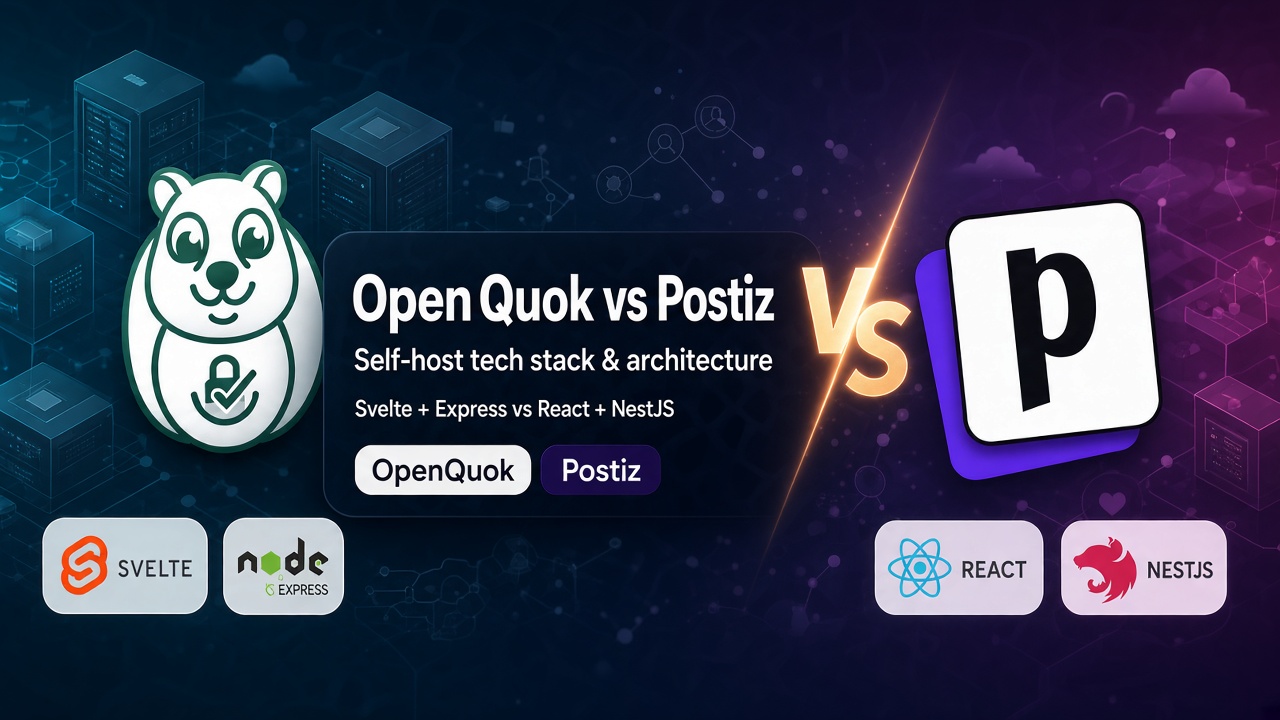
AI tools can write and change code faster than most teams could before. That shift pushes more teams toward custom software. This guide explains how to choose between OpenQuok vs Postiz as open-source self-host social schedulers. It uses congruent architecture as the lens: do your frameworks, services, marketing stack, and cost model support one clear principle, or do they fight each other?
For features and pricing, read OpenQuok vs Postiz — two open-source schedulers, different strengths and the compare page.
Horizontal, vertical, and custom software
Product thinkers often sort software into three buckets:
Horizontal software serves many industries with one platform. It optimizes for breadth: many features, one vendor, one way to run the product.
Vertical software serves one industry or job deeply. It optimizes for fit in a niche, often with presets and opinions baked in.
Custom software serves one organization’s rules, integrations, and constraints. It optimizes for adaptability, even when the starting point is open source.
Social schedulers look horizontal at first glance. Under self-host, you still choose how custom the result becomes. You fork workflows, add agents, wire MCP, trim services to match budget, or reshape marketing surfaces. AI coding assistants make that path more realistic because they help you edit plain modules across web, API, and workers.
Congruence asks which bucket you actually want. If your principle is “run the vendor’s full cloud-shaped stack,” a horizontal bundle can be congruent. If your principle is “one team, modest infra, agents, and our own glue,” you need a stack that stays easy to change—including how you publish SEO content without a separate headless CMS project.
Congruent architecture: what it means
“Good architecture” is a wide answer. Context and trade-offs always matter. A tighter test is congruence: do your design choices move toward one guiding principle, or do they fight each other?
Congruent means internally consistent. Every trade-off should support the same goal. When goals conflict, the architecture feels broken even if each piece is clever. When choices contradict each other, we call that incongruence.
Example — speed vs maintainability. You pick Java because the team can maintain it. Someone asks for Rust because it is faster. You say Rust is hard to read. Suddenly the real goal is unclear. Will you optimize for speed or for maintainability? The design is incongruent.
Example — reliability vs cost. You invest in queues, jobs, and replication to survive outages. Infra then allows one machine with no redundant site. You wanted stability and cheap ops at the same time, without resolving the conflict. That is incongruence.
Example — SEO vs product. You self-host a scheduler but bolt on a third-party blog with its own URL scheme, cache rules, and schema markup. Product pages live in one app. Articles live elsewhere. Crawlers and your team see two systems. That split is incongruent unless you planned for it.
Before you pick OpenQuok or Postiz, write down one guiding principle and hard constraints. Examples: lowest monthly cost, Temporal durability, MCP-first automation, or strict human review before publish on specific networks.
Built-in CMS and SEO—not only for schedulers
OpenQuok is not only a scheduling engine inside a thin wrapper. The same monorepo ships a marketing and content system built for SEO, wired to the product you run.
Operators use blog-manager in the dashboard to publish posts with topics, meta descriptions, reading time, hero images, FAQ blocks, optional HowTo steps, and product summaries. Public posts at /blog render CMS HTML with internal links normalized for crawl equity, table markup wrapped for accessibility, and structured data emitted at SSR—BlogPosting, breadcrumbs, optional FAQPage, and HowTo from the same fields you edit in the admin UI.
That pattern applies whenever you run any SaaS on this stack—not only social scheduling: programmatic hubs (compare, channels, tools), config-driven landing and FAQ copy, in-app docs with tech-article schema, and one origin for product plus content. For a custom or vertical SaaS fork, you extend routes and CMS posts on the same deployment instead of bolting on WordPress or a separate docs vendor on day one.
Framework fit in the AI coding era
OpenQuok centers on Svelte 5 (SvelteKit) for web and Express.js for the API. Svelte keeps component logic close to markup. Express is a thin Node routing layer. That combination is congruent with custom software and AI-assisted edits across plain modules.
Postiz typically ships React and NestJS in the open-source tree—a strong horizontal product stack with conventions and Temporal at the center. It fits teams who will run the product as designed rather than reshape internals often.
OpenQuok self-host architecture and tech stack
OpenQuok splits runtime into separate services: web, API, orchestrator workers, optional browser extension, and programmatic clients. Data and async work use Supabase (or your Postgres path), Redis with BullMQ, and storage you configure.
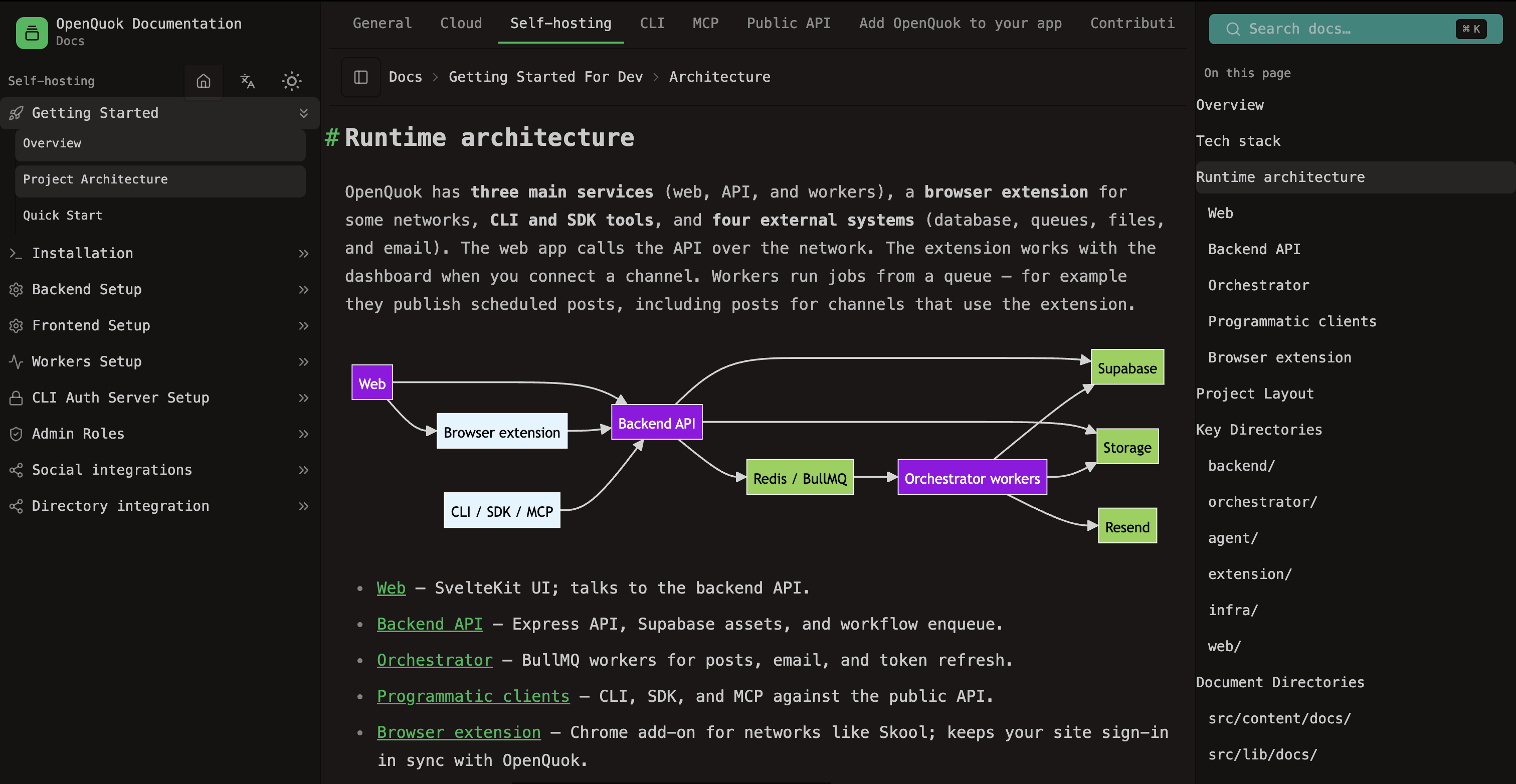
See Project Architecture. In short:
Web — SvelteKit (marketing, workspace, docs, blog, SEO landings).
Backend API — Express.js (REST, auth, blog-system APIs, enqueue).
Orchestrator — BullMQ workers (publish, tokens, email, reconciliation).
Clients — CLI, Node SDK, MCP, browser extension.
Self-host: Self-hosting, Docker Compose, MCP getting started.
Web layering: separate UI from business logic
OpenQuok keeps Svelte templates thin. Repositories fetch the API and map wire shapes to domain programmer models (PM). Presenters turn those into view models (VM) for each screen—loading state, errors, toasts—and call repositories instead of embedding fetch logic in markup. Page presenters in area-protected, area-public, and area-admin orchestrate a route; feature presenters own reusable slices (scheduler, blog upsert, settings).
That separation of concerns improves maintainability: you change an API contract in one repository file without rewriting every table and modal. You can unit-test presenters with stubbed repositories. AI coding tools can target a single layer instead of mixing business rules into .svelte files. The same pattern covers the workspace, secret-admin blog CMS, and public compare pages—congruent with a custom SaaS you will extend over time.
Contributor rules for this layering live in the repo under .cursor/rules/web-repository-presenter-architecture.mdc. Human-oriented summary: Presenters and repositories on the architecture doc.
You can review the full source in our GitHub repository.
Postiz self-host architecture and tech stack
Postiz documents frontend, backend, and orchestrator services—often in one Docker image—with SQL database, Redis, Temporal, and storage. Hosted operations use a multi-service cloud layout (compute, managed database, cache, workflow visibility, Temporal roles). That fits high availability; it is a different congruence target than one modest VPS.
For Postiz infrastructure, the backend starts Temporal workflows; the orchestrator runs durable publish and token jobs. The OSS tree typically uses React and NestJS.
Self-host cost and congruence
License price can be zero for both AGPL schedulers. Infra price follows architecture. Postiz’s production-style cloud layout adds fixed monthly cost at scale (multiple hosts, Multi-AZ database, Temporal cluster, search for workflow visibility). That is congruent when your principle is cloud production. It is incongruent when your principle is one small server.
OpenQuok emphasizes web + API + BullMQ workers without a mandatory Temporal cluster for the default story in Project Architecture. Many teams use Docker Compose on hardware they size. AGPL has no software fee; you fund what you provision—including CMS and SEO on the same stack.
Social scheduler tech stack compared
Dimension | OpenQuok | Postiz |
|---|---|---|
Software model | Custom-friendly OSS + in-repo marketing SEO | Horizontal scheduler product |
Built-in CMS / SEO | Blog manager, FAQ/HowTo fields, programmatic hubs | Scheduler-centric; marketing often separate |
Web maintainability | Presenter/repository layering; thin Svelte templates | React/Nest product conventions |
UI / API | SvelteKit + Express | React + NestJS (typical OSS) |
Async jobs | Redis + BullMQ | Temporal |
Congruent when you need | Modular self-host, MCP/API, CMS on one origin | Temporal durability, bundled agentic product |
When OpenQuok is the better self-host fit
Custom behavior, agents, and marketing on one monorepo with built-in blog CMS and SEO.
Svelte + Express and presenter/repository layering for long-term maintainability.
BullMQ instead of operating Temporal at your scale.
Public API, MCP, CLI, extension handoffs (Browser extension).
Small-footprint self-host (Self-hosting).
When Postiz is the better self-host fit
Temporal-first scheduling and Nest/React as your stack.
Many networks and agentic automation inside one product bundle.
Production-grade cloud infra and cost as a trade-off for availability.
Marketing stack already lives outside the scheduler repo.
Feature compare: strengths, Postiz alternatives, compare.
Summary
How to choose: match tech stack and growth stack to one principle.
OpenQuok uses SvelteKit, Express, BullMQ, presenter/repository web layering, built-in CMS SEO, MCP/API—fits custom and cost-aware self-host. Start with Project Architecture (see presenters and repositories) and compare.
Postiz fits Temporal-centric, framework-integrated horizontal scheduling at cloud scale.