
Feeds spent 2026 arguing about the same mismatch: you thought a person wrote it, and it reads like no one did. Platforms are reacting in different ways — a scan button, a required label, a ban from the community, a Search ranking drop. None of that rewrites the sentence in front of you.
OpenQuok Humanizer is a free pass over a social draft so it reads less machine-written. It does not hide you from a detector, skip a label, keep a moderator from removing a post, or restore pages hit by a spam update. For how the rewrite is wired (catalogs, Chrome Rewriter, local fallback), read How OpenQuok Humanizer rewrites a draft in the browser.
Substack: readers can scan the text
In July 2026, Substack CEO Chris Best published Against Claudefishing and shipped a reader-facing scan. On web and iOS, anyone can run “Scan for AI text” on notes, replies, comments, and posts longer than 100 words, published from that launch onward. The result is private to the person who asked. Creators can scan their own drafts, dispute a scan, and add a “How I make this” note so subscribers know the process.
Best’s point is not “never use a model.” It is the mismatch: a reader invests attention in something with no human thought on the other end. He does not want the app to feel like a LinkedIn comments section. The scan estimates whether AI shaped the words. It cannot tell whether you cared about the piece.
That is a style classifier on a newsletter platform. Clearing it is not a product goal here, and we do not claim it.
TikTok and YouTube: realistic AI has to say so
TikTok requires a label when a post is completely generated or significantly edited by AI and shows realistic people, audio, or scenes. Use the “AI-generated content” toggle (or a clear caption, watermark, or sticker). TikTok can also auto-label official effects and files that carry C2PA Content Credentials; a platform-applied label cannot be removed. Unlabeled realistic AIGC can be taken down. Stylized or obviously fake clips are a greyer area. Captions, scripts, and hashtags written with a model are not the same as a synthetic face — TikTok’s integrity rules are about whether the media could be mistaken for real footage.
YouTube followed in May 2026: more visible AI labels under long-form videos and as a Shorts overlay, plus automatic labels when systems detect significant photorealistic AI. Creators still have to disclose realistic AI at upload. Some labels stay put (YouTube’s own generators such as Veo, or C2PA that says the file is fully generative). A label alone does not decide recommendations or monetization.
If the video is synthetic, disclose it. Humanizer will not un-label a clip. What it can do is clean the TikTok or YouTube caption so the text around the video is not the part that sounds templated.
Reddit: communities ban the slop, then the account
Reddit Inc. does not run a sitewide “no AI” rule. Moderators do. Ars Technica reported volunteer mods spending more time removing generative posts as volume rose. A Cornell study of Reddit moderators found the same fear: quality drops, detection is hard, and some boards treat it as the most disruptive threat. In writing communities the line is blunt — one WritingPrompts moderator told researchers, you are not allowed to use AI there, and you will be banned.
So users get removed more often not because of one Reddit button, but because more subreddits now treat undisclosed AI as spam, bad faith, or against the rules. A polished “here’s the thing / at the end of the day” comment is easy to spot in a casual thread. If you still post there, write like a person in that room — or do not post.
Google Search: spam updates hit mills, not a caption
Search is another surface, with a different lever. In August 2026 Google rolled a spam update that applied globally and to every language. The dashboard logged it as a ranking incident from 18 August through 21 August 2026 (US/Pacific). Google called it a normal spam update: better automated detection, existing spam policies, no new policy type announced with the rollout.
Google did not publish a target list. Operators still read it as a hit on programmatic SEO farms: thousands of near-duplicate location or comparison pages, often model-written, shipped to rank. That pattern already matches scaled content abuse (mass-produced pages, no matter how they are created). Sites that violate those policies can rank lower or drop out. Recovery, if it comes, takes months of the systems seeing the site comply.
A Substack scan, a TikTok label, and a Search spam update are not the same job. Humanizer will not put a thin mill back in results. It only rewrites the social draft in front of you.
Models also mark output. Readers still see the habits
Providers are adding machine-readable marks (invisible text watermarks, file credentials) so another system can ask whether a model was involved. That is a provenance signal. It is not the same as a subscriber noticing “it’s not X, it’s Y,” “delve,” a pep-talk ending, or an em dash in every paragraph — the slop list Hassid walked through in public.
A watermark does not delete those tells. A Substack scan, a TikTok badge, a Reddit ban, and a Search spam update also do not rewrite them. Your LinkedIn or X audience is still reading the words.
What Humanizer does — and does not
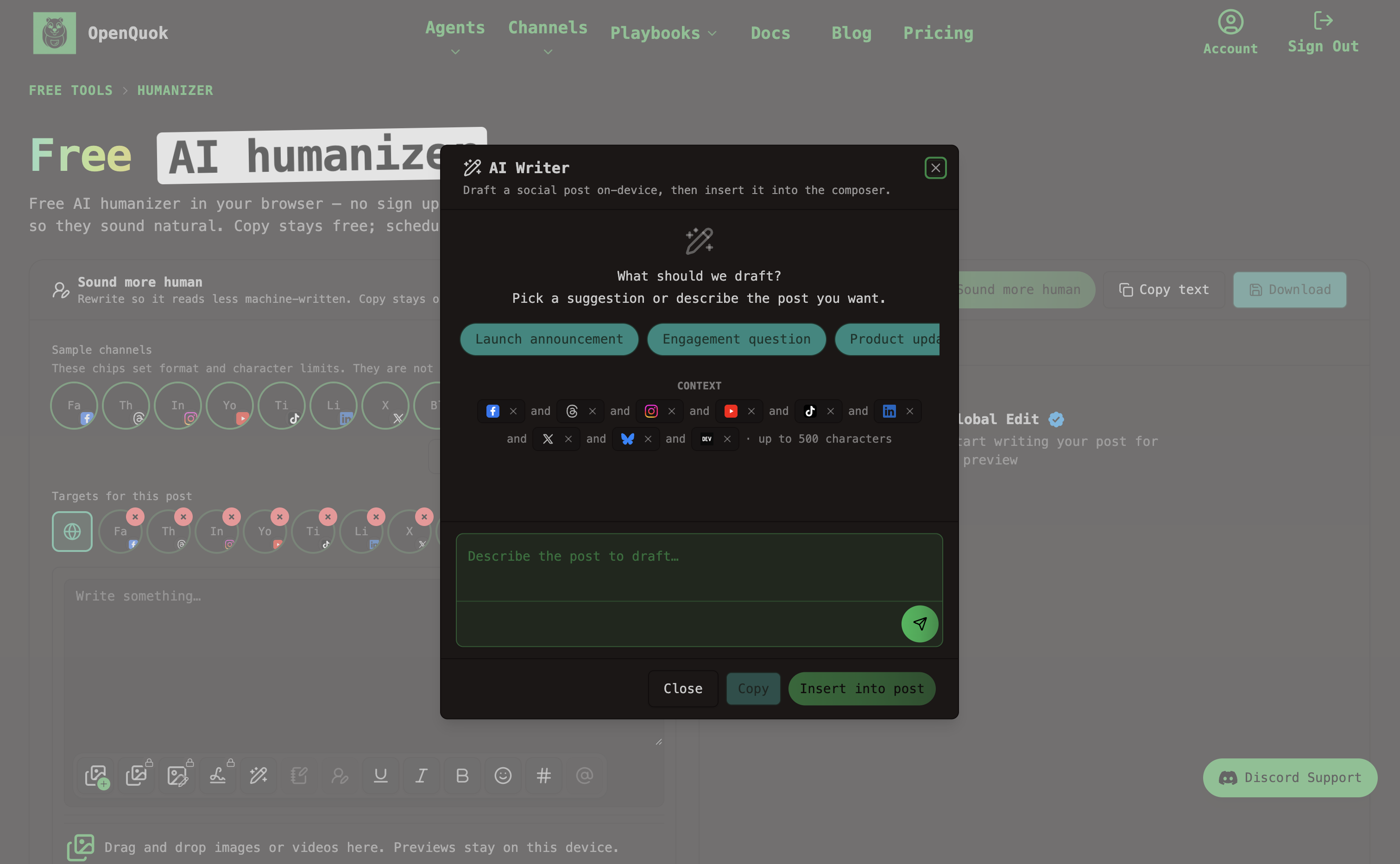
Humanizer rewrites a social draft so it reads less machine-written. Human (default) cleans stock phrasing and varies rhythm. Roughen is more spoken; review any invented names, dates, or prices before you post.
It runs in the browser. In supported Chrome, that uses the on-device Rewriter. If Rewriter is missing, a local phrasing cleanup still runs. Copy and download stay free. You do not need an account to use it. The catalogs and both rewrite paths are in How OpenQuok Humanizer rewrites a draft in the browser.
It does not beat a newsletter scan, strip a provider watermark, replace a required AI label on realistic video, or recover rankings after a spam update. Review the output. Keep your own facts. Follow each platform’s disclosure rules when the media is synthetic.
The composer shows sample channels so you can preview format and character limits. Those chips are not your accounts. Connect real channels in the workspace when you want to schedule — Humanizer itself never publishes.
Try a platform page
Start on the generic tool, or open a focused rewrite: LinkedIn Humanizer, X Humanizer, TikTok Humanizer, YouTube Humanizer. Network setup lives under supported channels.
The rewrite shipped in the OpenQuok web app; history is on GitHub.